
Bed functions

View comparison as a table
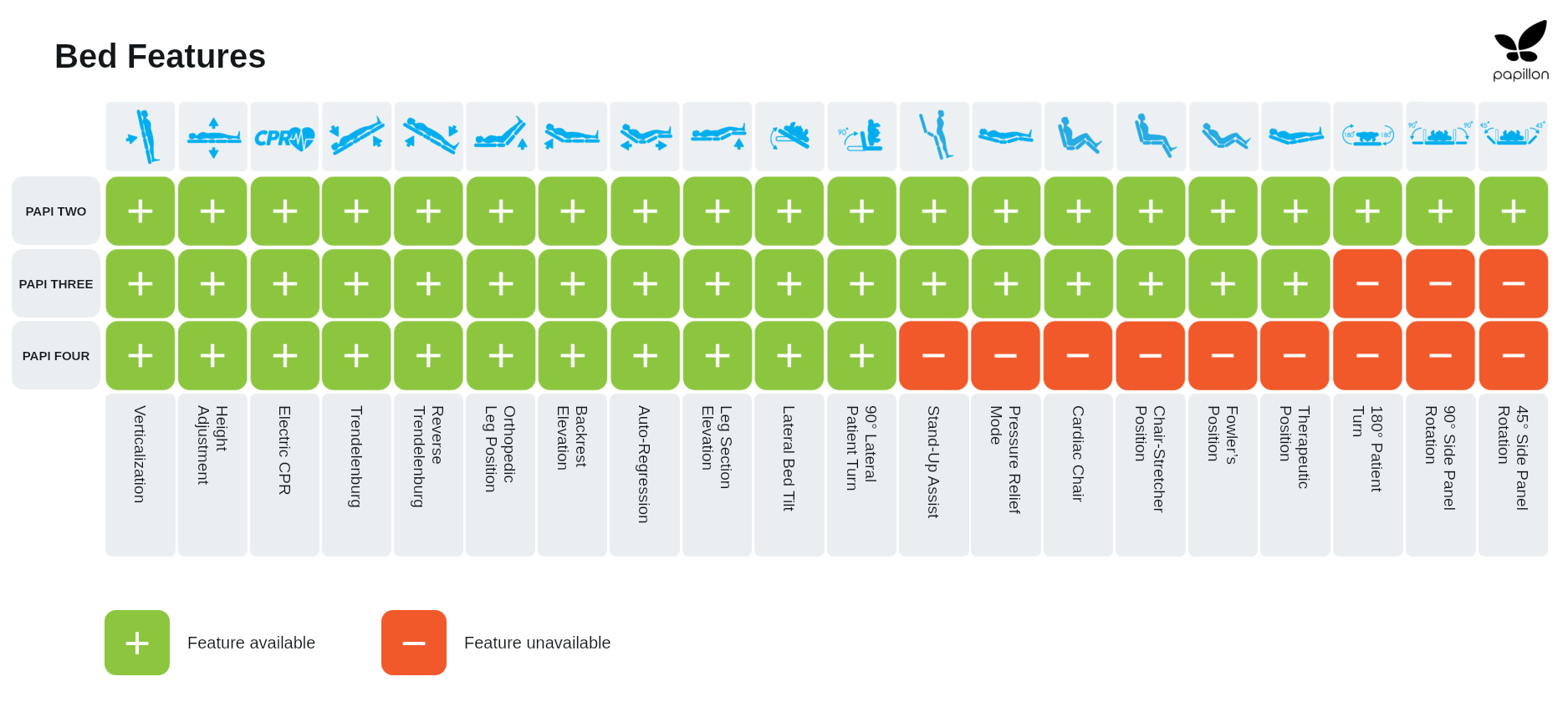
| Function | PAPI 2 | PAPI 3 | PAPI 4 |
|---|---|---|---|
| Patient verticalization | + | + | + |
| Height adjustment | + | + | + |
| Electric CPR | + | + | + |
| Trendelenburg position | + | + | + |
| Reverse Trendelenburg position | + | + | + |
| Orthopedic leg positioning | + | + | + |
| Backrest elevation | + | + | + |
| Auto-regression | + | + | + |
| Leg section elevation | + | + | + |
| Lateral bed tilt | + | + | + |
| 90° patient side turn | + | + | + |
| Stand assist | + | + | − |
| Pressure injury prevention mode | + | + | − |
| Cardiac chair position | + | + | − |
| Wheelchair position | + | + | − |
| Fowler’s position | + | + | − |
| Therapeutic leg positioning | + | + | − |
| 180° patient turn | + | − | − |
| 90° side-panel rotation | + | − | − |
| 45° side-panel rotation | + | − | − |
+ Available · − Unavailable
Backrest elevation
Raising the backrest supports basic activities such as eating and drinking, makes bedside care easier, and helps maintain the patient’s quality of life. It also allows caregivers to reposition patients with limited mobility as part of pressure injury prevention.
Leg section elevation
Leg elevation is used in rehabilitation and to help prevent fluid pooling in the limbs. The original use cases also include passive leg raise testing and positioning during hemodynamic instability.
Fowler’s position
The patient lies on their back with the head of the bed elevated, between lying flat and sitting upright. This position can be used for personal care in bed and as part of pressure injury prevention for patients with paralysis.
Cardiac chair position
The bed moves the patient into a seated position with the knees bent. This option is intended to support cardiovascular and respiratory function in patients who spend extended periods in bed.
Pressure injury prevention mode
The bed changes the position of individual sections relative to the patient’s body. This mode supports repositioning as part of care for pressure injuries and other complications of immobility.
Lateral tilt
Lateral tilt changes the patient’s side-to-side position and can be easier to perform than a full turn onto the stomach. It is used in care protocols intended to support respiratory function and manage complications associated with immobility.
Side turning
Turning the patient onto their side helps staff change briefs or bed linen, position a bedpan, and carry out bedside procedures. The patient can be positioned on their side for ongoing care or turned briefly as needed.
Trendelenburg and reverse Trendelenburg
Trendelenburg lowers the head relative to the feet. The original page describes its use in hospital resuscitation and passive leg raise assessment, where clinically indicated.
Reverse Trendelenburg raises the head relative to the feet. The position is used in some rehabilitation and respiratory care protocols for patients who have spent extended periods in bed.
Height adjustment
Set the bed at a height that is comfortable for staff and supports safer patient transfers and bedside care.
Patient verticalization
The bed platform tilts up to 70° from horizontal. Patient support straps are used during the transition. The function supports gradual preparation for an upright position and can be incorporated into rehabilitation for patients who have been immobile.
Therapeutic leg positioning
Adjust the position of the lower body to suit the patient’s diagnosis and overall condition, as directed by the treating physician.